


Charles Fort
Chapter 23 – Limited Space: An Excerpt From Gregor Samson’s Akashic Memoir
A reflection:
There is a valid reason to explain my great affinity for Charles Fort.
It was a few years ago. My life was a malaise, a perpetual gray cloud hovering over every facet of existence. I was recovering from a traumatic state of circumstances: the destruction of my marriage and parental rights being stripped away like they were just a pair shoes torn off my feet. One minute you’re a dad, the next you’re just another shmuck off the street. Fatherhood is a flip of a coin: heads, your weekend for playing in the park with that little girl who looks up to you more than any other guy; tails, back to the loneliness of bachelorhood. It’s a schizophrenic existence and tough to walk in any sort of balanced framework.
Eventually my role became diminished. Circus Dad that Alice only wanted play-things from. There was no respect, no connection, no serious embodiment of the paternal nourishments I so longed for long ago. As well, any attempts from her mother to shut me out of her school life, church life—anything else that might have made me a real father—were ignored by the courts on the traditional basis that “mother knows best.”
Well . . . she knew best on how to diminish my status of fatherhood to such a point that defeat was inevitable. I became a broken filament. The shattered pieces of purpose were no longer there to try to piece together. I was lost; no stones to toss, nothing to throw them at.
My marriage was no better even when we were legally bound. The gray was always there, almost dream-like, walking through fight after fight after fight. We were never meant to be together, and I think I remember one night, waking up, looking over at her pale skin and auburn hair and thinking to myself, “Who is this person? How did I get here?” Even though that marriage was a prison I tried so hard to break from, the fallout was so destructive on my psyche it shattered my immune system—contracting a plethora of conditions consuming my body’s ability to function in any normal capacity. External dependencies on chemical agents were a must! In a coalesced haze of social disparity and physical illness, I wandered aimlessly from month-to-month; a beleaguered automaton inept at any prospect of joy or fulfillment.
One day, I stumbled into Spivey’s Bookstore on Westport. Spivey’s is housed in a rugged brick building constructed in 1910, five floors of nooks and crannies and portals to dark places. Ol’ David Spivey himself sat on a rustic, beaten chair covered in soot and dog hair, near the back of the dilapidated tenement. He’s a caricature of himself, munching on his cigar and reading stacks of yellowed newspapers through bottle-lensed spectacles. A droopy bloodhound lay quietly at his feet as a chestnut colored Great Dane with bulky hind-legs lumbered quietly around the corner to see who entered through the bell-tinkle door. The old fray-haired lady at the counter with twinkly eyes smiled at me. Ol’ David never interacts with customers, just sits there quietly reading his decades-old newspapers. The place is a concoction of rooms randomly situated with no rhyme or reason other than to stack shit: old dust-worn tomes a century old; cluttered piles upon piles of maps of the world when countries had different borders, or when the New World was uncharted territory; books capriciously stacked out of order on crooked shelves along with bowls of water, dog food, and cat food; and yes, the occasional feline languidly brushing by your feet as you peruse the cobweb aisles. I love the place.
This one particular day, I was in the basement, next to the water heater, sluggishly browsing the book stacks of (mostly) biographies. I was in a supine mood. But I happened upon a hardback with golden leaf embroidery and a torn spine. Don’t know why it caught my eye . . . many pages were missing, including the publishing information and title, but scanning the book I realized it was a series of non-fiction articles about a man named Charles Fort and his eccentric ideas. The last half of the book contained excerpts from Charles Fort’s own publications The Book of the Damned, New Lands, Lo!, and Wild Talents, along with essays from various writers regarding his unpublished works X and Y. Flipping through the dingy, crumpled pages I came upon a passage chiming and glimmering among all the others:
“ . . . there are no coincidences, in the sense that there are no real discords in either colors or musical notes. That any two colors, or sounds, can be harmonized by intermediately relating them to other colors or sounds.”
Without knowing a thing about this Charles Fort guy, I purchased the compilation immediately.
So, who is Charles Fort? And why is he so important? The books highlighted in this unknown volume are the pinnacle of Fort’s achievements from the late 19th and early 20th Centuries. Charles Fort, I would say, is the god-father of the layman’s investigation of anomalous phenomena. Fort wasn’t a scientist, in fact, never even finished high school. Apparently he wanted to be a famous writer and never succeeded in his fiction work. Depressed from the negative reviews of his first novel, Fort began spending his spare time in the New York Public Library. For years and years he read . . . pretty much everything: newspapers, scientific journals, history, astronomy, psychology, and sociology, whatever he could get his hands on. Reading through a plethora of various articles, stories, and other accounts, instances of unnatural events began to trickle to the surface. Interested in data normally ignored by mainstream science and culture, he uncovered hundreds upon hundreds of eye witness accounts: frogs raining from the heavens; fish raining from the heavens; unexplained disappearances; cases of spontaneous combustion; unidentified flying objects; cryptozoological sightings; ghostly apparitions; aerial phenomena, such as ball lightening and airships (before there were any such thing); and so on. Fort recorded these anomalies on tiny little strips of paper he filed away in shoeboxes labeled by category of phenomenon. What few friends he had marveled at the stacked columns of shoeboxes lining his apartment walls.
After years of collecting these notes, to Fort, a pattern emerged.
The product of that pattern was X. To Fort, X was the great mystery, an external or objective force that guided all things. In all of Fort’s reading he discovered a universal law, a formula underneath all seemingly disparate things. This force acted as a great attractor, or influencer on all of society, all nature. In essence, Fort was a believer of orthogenetic evolution. He believed evolution was not a set random processes, but a guided system headed toward one great goal. However, this goal was a malevolent one, directed by a force which convinced us we had free will whereas free will was actually a simulation:
“I shall try to show that X exits, that this influence is, and must be, evil to an appalling degree to us at present, evil which at least equals anything ever conceived of in medieval demonology.”
Fort even went so far as to blame this presence for his publishing foibles: “I suspect that strange orthogenetic gods are mixed up in all this.”
So, what unearthed for me were two realizations: a.) Charles Fort was the godfather of supernatural inquiry, until he came along no one took seriously the notion of approaching the subject in an investigative manner; and b.) Charles Fort was also, according to my own researches, the godfather of modern conspiracy theory in a time when science and reason ruled the psychological and sociological landscape.
In fact, according to Fort, X ruled over all. Even, as this sentiment bellowed into my gut, over reality and consciousness itself:
“I am convinced that everything is fiction.”
This was when I was indeed convinced, or rather vindicated, of the unreality of reality.
So it was that I became a Fortean. His legacy has continued through the long-lived Fortean Society and a publication of anomalous phenomena called The Fortean Times.
I recall, not too long after getting that book, I had a visionary experience of the nightmarish variety. A flash of light flickered across my perception and I collapsed to the floor. Do I hear music? If there is music at all . . . it is the sound, it is part. Then, on the ground, I felt fluid, underwater liquid motion of my body, all feels underwater. Consciousness is not lost. I was fully aware of what was going on and immediately . . . there is no wait—no second—no mere moment . . . I was immediately pulled away from the waking reality without warning—the beast crawls through my ribs. But, there is no choice, I stay with it. I have to. I am being pulled out of this world and all I can think of is I am leaving Alice behind; I want to be with Alice . . . but she is back there, in that world asleep at her mother’s—at Kathleen’s—house away from me, because now I am in another place and time entirely. Parts of me, little streamers of dull luminescence, get tugged underground, roller-coaster streams, rungs in a pulley being tugged and dragged underneath . . . to an Other world.
I am slipping in. I hear my mouth, my body back there in that other place, screech in shock, in terror of being gone. The beast in my ribs jumps into my stomach and laughs.
First, the legs go under. Then, the mid-section and torso. All the way to my head. Then, before I know it, I am THERE. There I am. No, no . . . there is no other . . . there is . . . I am in this world, but I am in another . . . this world . . . the other, an eye (so much bigger).
I awake in the eye of me (so much more than this) and, no . . . it is Lovecraftian! I am in a room somewhere, in a vast place—that is nothing—some space of a building. It is limited. I am, right now, you are, right now, we all are, right now, out in a limited space somewhere(when) . . . and I am dreaming away, dreaming this world (the one whose denizens are reading this) and that is what life is . . . merely a dream, literally . . . a fabrication . . . a fantasy . . . because I, and others like me trapped in this limited space inside this building, complex, pod space in somewhere(when) (resonating with almost every dream I have ever had, every dream I am in this complex, this building, maze, and I am trapped in there and that makes up that entire world, that entire universe, dimension) and that is real, that is where I really am and here . . . here we are all dreaming this, we are all trying to get away from that limited space and concocting this whole experience we call “life.”
What is terrifying through this episode is that this concept is no longer an idea, it is real. I am Here. I am in This Room. Then, feeling the pull, tugging back into the dream, into the reality-dream that is my apartment and Alice and Kathleen . . . this is all I have in the face of what is waiting for me when I finally wake up; when we wake (die) we go back to that space, those corridors that are emptiness and it (they) are all watching me, a matrix revealed, it really is.
Fear boils at this point . . . I want back, back into the dream, into the place where we can revel in the things that don’t matter because what lies beyond is something, and that somewhere(when), it is that limited complex of building, that small space, that we are trapped in . . . the us, maybe all of us in one, person among a few—am in, I am in the room there, wooden floors, I am lying on the floor, no bed or mattress or furniture and I see my eye, looking at me here in the dream because the barriers have been broken by that flicker of light, the veil lifted, eye is bigger than the me in dream, in this realm. I know, and I say, ‘No, no, no, no ,no, no why are you trying to wake up? Go back and take care of the dream you have! No! What the fuck are you doing, take care of what you have now because when you get Here it is not enlightenment!’ You are really a prisoner trapped in a place of rooms among a few other people that are lost—you don’t know where they are—and it is terror because you don’t know who you are, who you are trapped by, and why or what for or what you are or where you came from, it is all all all all all all made up! This is all made up and when I slipped back into this realm, when I am slip-sliding, slithering back into this “conscious” world, the reality structures (so solid; not flimsy, cloudy, psychedelic stuff) reassemble. I can feel this fabricated world put itself back together, fabricate the illusion around me of sight, touch, taste, hearing, all of these lies we pass off as senses.
And I know then how fragile it all is.
All of this building block, tinker-toy reality is assembled and can fall apart so easily and it does all the time: we don’t understand . . . every minute lunatics break it apart; crazies who maim torment torture and control others and magicians break it all to pieces. Why are we doing this? We can’t let this dream fall apart because all of us . . . we are all fragments of mind gone awry, end up back in that same room we are trapped in (beyond forever because we cannot comprehend) the pace and time for the real reality to sink in; this is all NOT real, that is precisely why we HAVE to protect it! Keep the dream . . . for as long as we can . . . keep those fragments that are there because it is the only relief that we have in that wooden room that has Nothing on the other side, absolute Nothing in the universal sense. Don’t you understand what that means? WHAT? We (I, you) were a cosmonaut that breached that place of Nothing in a psychonautic scheme, and there we are at the edge of finality, finally cracking with lunacy, choked with the understanding that there is Nothing there! Oh God, we are (I, you) so scared, I want my life, my dream, my Alice, and let it last while it can—death is no solace . . . I cannot tell my little girl that anymore . . . life is the solace . . . death is the return to that insanity, that break . . . which is why life is precious, needs to be catered to. Treat it like a dream . . . free from thought . . . freeeeeeeee from emotion . . . true freedom without desire without want without need of security . . . there is no security, only then can we truly realize how to be, TO BE . . . . this is all a figment of our crazy imaginations. The only place that is Real, the place of the break, the matrix pod breach next to Nothing . . .
There is no eternity here!
This episode left me . . . isolated. Vulnerable. The Fortean way was—is—my only way out!
Maybe I encountered X, maybe I didn’t. But I want to find it . . . I want to make it mine so I am no longer afraid. So I’ve searched, been searching, for that common law, that underlying framework that governs everything. I became like Charles Fort. Because that is the only way out of the fear, isn’t it? To understand?
There is something wrong here. Something is not right with the world. Western civilization, more than any other civilization, has affected the ecological stability of the planet . . . being the most destructive force in human history. We blindly follow the shadows on Plato’s cave wall, what Jim Morrison calls “The Dim Cave.” Everything is dim; it is bleak, for that is how the mists of illusion are allowed to manifest a simulation of what is real, rather than display the ultimate and horrible truth.
The panacea for this plight in humanity, I am beginning to realize, is not some scientific remedy or political shake-up: it is merely a realization, an awakening. Mathematical cosmologist Brian Swimme advertizes our “cousin” relationship with everything in the universe, especially planet Earth. When science, from Newton’s womb, has tried drastically to isolate itself from Nature and its observations of Her makings, I can imagine Isaac pissing himself in his own grave when the percolations of quantum mechanics began to seed themselves in the scientific community.
Look at super-string theory: that all matter in the universe, down to its finest point, really just consists of tiny vibrating strings, smaller than the smallest particles known to man. These strings can experience an infinite number of vibrational patterns that are referred to as “resonances.” Physicist Michio Kaku likens this phenomenon to a musical instrument, the frequency of vibrations coming from the string determines the mass of the particles in which it resides. In his book on parallel universes, Hyperspace, he elucidates this idea:
“Matter is nothing but the harmonies created by this vibrating string. Since there are an infinite number of harmonies that can be composed for the violin, there are an infinite number of forms of matter that can be constructed out of vibrating strings . . . the universe itself, composed of countless vibrating strings, would then be comparable to a symphony.”
The Universe, I conceive, is a vast orchestra of vibrations whose music is composed by the strings that resonate inside every particle of existence. These strings are all equal, exactly the same in every way. The only difference from one string to another is the vibrational sequence that resonates from each one, determining the differentiation of the particle.
This is tantamount! The threshold of scientific discovery! Just recently, the Solar Physics and Space Plasma Research Center from the University of Sheffield discovered that our very sun emits acoustic sound waves in the milli-hertz frequency akin to “musical instruments such as guitars or pipe organs.” Beyond that, researchers at the University of Virginia spend their time analyzing the background radiation produced by remnants of the Big Bang, the primordial explosion that created the Universe. They have discovered that this radiance itself broadcasts sound waves that give an idea of how the Universe sounded during the first 400,000 years of its existence. Sound is everything! Vibration! Frequencies!
What I find most interesting is that the realms of mystics and primitive societies have known this about the Universe all along. Not only that, but these societies have always “listened” to the resonance offered by Nature. Again, Brian Swimme has discussed how the aim of primitive peoples was to live in “resonant participation” with the Universe, which is how the drum came to be one of their most sacred instruments:
“The drum was part of the sacred techniques for orchestrating the unity of the human/universe dance . . . In their rituals and in their life in nature, the first peoples attended to the music sounded in their depths by the surrounding mysteries.”
Primitive societies strove to live in harmony with the frequency of the world around them. Through the drum they were able to tune themselves in to this frequency and direct their lives in accordance with this rhythm. It is determined that the shaman, the medicine man, has always been the leader of these primitive cultures in this regard. The shaman’s main function, according to mythologist Joseph Campbell, is “to keep mankind in accord with the natural order.” The shaman is the one who instructs the society. The shaman is the one who experiences the resonance offered by the Universe and imparts what he/she learns to the people. Brian Swimme believes that because of this new knowledge we have of the cosmos (i.e. – quantum theory), science must accept and embrace the shamanic way of life:
“. . . the scientist must participate to some extent in the shamanic powers so characteristic of human presence to the universe in any significant manner. The capacity of Einstein to transform the Newtonian science of his day through his teaching of relativity required a shamanic quality of imagination as well as exceptional intellectual subtlety. So we might say that the next phase of scientific development will require above all the insight of shamanic powers, for only with these powers can the story of the universe be told in the true depth of its meaning.”
Joseph Campbell, as well, recognized the ability of the shaman to listen to the resonance of the cosmos. Since the strings that comprise us are all the same, we can assert that Carl Jung’s “collective unconscious” is an extension of the vibrations that resonate from these strings. What the shaman receives from their ecstatic visions and experiences rings throughout the orchestra of the Universe, and what it is saying is that “We are all the same!” “We are only different from nature by choice!” “We must live in tune with the symphony of the cosmos!” “We are a collective!”
The problem with the modern human is that we do not act like a collective.
You want to end war? Famine? Poverty? Hate? Want to protect the fragility of this dream? Then consider this: we are all made of elementary particles. Each particle is made of a vibrating string. Each string is exactly the same. We are all exactly the same. As well, this is the same for every particle in Nature. We exist of the same elementary particles as everything in Nature: trees, rocks, birds, coyotes, elephants, worms, jellyfish, clouds, stars, etc. Every organism in the Universe, every string, is identical. We are only differentiated by how much these strings vibrate. We only differentiate from anything else in Nature, and ourselves, by our resonance. We are defined only by our vibrational frequency. The Butterfly Effect remains true in this energetic conglomeration; the vibrations of one’s suffering—from the smallest flower—resonates throughout the rest of the cosmos—to the largest star.
The great mystic Jiddu Krishnamurti understood. He understood that, not just philosophically, we are all part of the same stuff. “There is no difference between the individual and the collective,” he said. “I have created the world as I am.” He understood that the world is not an external object from the person, a thing to be tested in a laboratory. Krishnamurti’s statement is that we are in a constant state of participation at all times with the world, we are never not participating!
“I can observe myself only in relationship because all life is relationship.”
These are the words of understanding the world. Not controlling it. Not dominating it. These are the words of integration, not war. Assimilation, not segregation.
It is my assertion that the key to this integration and assimilation is in the recognition of ourselves as patterns of vibration, and nothing else. There is nothing to fight about, because those borders you see dividing this land from that are just an illusion . . . just a dusty old map lost in Spivey’s tottering stacks. What X is, is ego. For it is ego that asserts our individuality over all else. It is the ego that says “I am” and not “us.” Ego tells you to stand up for yourself, to forget about the other person’s needs, where they are coming from, what their plight is. They don’t have the history that you do, after all . . . ego establishes those walls building up stalwart around you to protect you from all the badness in the world. “A confident man is a dead human being,” Krishnamurti said. That is because a confident man believes he has nothing more to learn, believes he and only he is in the right, the Universe could only be on his side. He is clothed in the drapes of ego, they keep out the weather of collectivity. No need to ponder over the needs of others, it is I that must be looked after, he would say.
He forgets about the orchestra. He forgets that the conductor is conducting us all. His instrument is no better than any of the others.
What allows this ego to work is fear. Fear of losing identity. Therefore, control comes into affect . . . by controlling one’s environment, one controls the security of one’s identity. So, in essence, what if the Dominators, the Illuminati, the governments and politicians and corporations are not all deliberately part of the same plan? What if they do not meet in small gatherings in tribute to X, this malevolent force that directs us all, that exerts its control over our lives? What if they are not as organized as most of us in the conspiracy community assume?
What if they are all just normal dicks like the rest of us?
Then, why does it all point to something? Why does everything get traced to something, some X, pulling the strings? Is it the Illuminati? The Dominators? The Brotherhood of the Dragon? The Freemasons? Grey aliens? Who? What?
A further sentiment from Krishnamurti rings true: “The simple fact is that we are afraid, not that we are afraid of this or that.”
The true conspiracy is not that we are being controlled by aliens, the Illuminati, or X. The true conspiracy, we should realize, is that we are all being controlled by ego. That is why everything is so scary, because ego survives by turning everyone—everything—into a conspiracy. That’s how its identity remains intact.
The only true conspiracy is ego itself!
(Italics quoted from Kahlil Gibran's The Prophet)

People of Orphalese, beauty is life when life unveils her holy face.
But you are life and you are the veil.
Beauty is eternity gazing at itself in the mirror.
But you are eternity and you are the mirror.
* * *
For our anniversary celebration, my wife and I attended a Mesada, a Medicine Ceremony of the San Pedro cactus (or Huachuma). I was completely terrified.
A couple of years ago I underwent an entheogenic experience (without the proper ceremony or setting, of course) and it ripped me to shreds. I felt torn away from the world in a horrific, isolated way. Instead of making me better, it made me worse, resurfacing old haunts within my psyche. I opted never to go back to that space ever again.
But, as circumstance would have it, synchronicity aligned us to this juncture. As scared as I was to undergo another “psychedelic” experience, the opportunity seemed to fit just right with the stars. The shaman assured me everything would be fine, he would be there to facilitate my healing. I also have a heart condition that arises during panic, derived from when I was diagnosed with Post Traumatic Stress Disorder. He said San Pedro would take care of that too, calling it (what his wife termed) “a masterful lover.”
The San Pedro cactus (Trichocereus pachanoi) is one of the oldest entheogenic substances used in shamanic practice that we know of. Originating from the Chavín culture in northern Peru, San Pedro can be found in carvings dated as far back as 1300 B.C.E. The name San Pedro was adopted during the early European colonization of Latin America. A legend exists of Saint Peter using the mystifying powers of the cactus to uncover the hidden keys to Heaven to share with all humanity. Leading scholars of shamanic studies, Ross Heaven and Howard Charing state: “Considered the ‘maestro of maestros,’ San Pedro enables the shaman to open a portal between the visible and the invisible world for his or her people.” San Pedro is known to be a great healer for all ailments mental, physical, emotional, and spiritual. This may all sound baffling to the average person, but the shaman’s claim is that nature is minded: “A plant may not talk, but there is a spirit in it that is conscious, that sees everything, which is the soul of the plant, its essence, what makes it alive.”
As we arrived at the shaman’s lodge, my fear boiled inside of me, causing my heart to throb so hard it affected my vision. There were approximately 20 people attending the ceremony, including the two auxillios (the shaman’s proxies available to assist us with our needs and hold the space as a sacred container). We waited nervously outside the main lodge as we listened to the shaman rattle and sing inside. We were called in one by one.
I was placed in the northeast section of the chamber. The shaman knows who we all are weeks in advance, spending this time preparing the San Pedro brew with our names, our prayers. As well, he has systematically configured the room to align our energies with the four cardinal points. As we were all seated, he gently explained the process of the night. Then, we opened the ceremony by charging the mesa.
A mesa is “a shamanic altar containing ritually empowered objects, which are aesthetically arranged on a sacred textile to reflect the system of medicine work employed by its carrier.” The mesa also reflects the four directions, symbolizing the four elements which we paid homage to: Pachamama in the south, representing Mother Earth; Mama Killa in the west, representing water, Grandmother Moon; Wiracocha in the north, representing air, the world of Spirit; and Inti in the east, representing fire, the Sun. Finally, K’uychi in the center is charged, the universal hub of all that is, the axis mundi. The shaman facilitated an energetic interaction between us and the mesa, which would be the central anchor of the night’s ceremony. All nourishment, even water, would come only from the mesa for the rest of the evening.
The shaman blessed the San Pedro brew and drank it first. He drinks as we drink, enabling him to energetically see, diagnose, and treat our ailments. Then, he called us up to drink from the same cup, one by one. When my name was called I almost passed out in anxiety. When I stood, I shook with catatonic fright, dizzy with heart-pounding anxiety. Maybe I can back out, I told myself. I don’t have to do this, do I? I was constantly rehashing Terence McKenna’s statement in mind: “A touch of terror gives the stamp of validity to the experience because it means, ‘This is real.’” However, I recalled the shaman’s advice to me weeks before: “If you are afraid of it that means it is exactly what you need to do.” I have to overcome my fear.
I placed myself on the south side of the mesa, facing the rest of the chamber. I clasped the cup in my trembling hands and whispered my prayers into the brew: “Give me courage, San Pedro. Help me to overcome my fear, my pain. I want to know how to love. Make me a vessel for Spirit.” I held the cup up to the members of the room. “Salud!” Everyone repeated back: “Salud!” And I drank.
No way back now, I said to myself. Best just surrender to the ride.
* * *
Your pain is the breaking of the shell that encloses your understanding. (…)
Much of your pain is self-chosen.
It is the bitter poison by which the physician within you heals your sick self.
Therefore trust the physician, and drink his remedy in silence and tranquility…
* * *
Everyone finished and we settled into our positions. The shaman and his auxillios blew out the few remaining candles in the chamber, making it completely dark save for the faint moon glow through the windows. Huachuma ceremonies generally take place at night, in utter darkness. Mythologist Joseph Campbell asserts, “Since the yonder world is a place of everlasting night, the ceremonial of the shaman has to take place at night.” Though the sudden darkness was very jarring, I readied myself for the unknowable.
Before beginning his healing work, the shaman appointed the first hour to allow San Pedro to work within us. I focused intently on my breathing, trying to calm my heart. In and out, fueling my body with the rhythm of breath. Before long I began to see and feel the San Pedro in my stomach. It appeared as a luminescent purple globule inside of me, reaching out with octopus-like tentacles. I remembered what McKenna terms the “violet psychofluid”, seen by shamans under the influence of the entheogen ayahuasca: “. . . a substance that is described as violet or deep blue and that bubbles like a liquid. (…) This violet liquid comes out of your body; it also forms on the surface of the skin, like sweat. The Jivaro do much of their magic with this peculiar stuff. (…) The nature of this fluid is completely outside of ordinary experience: it is made out of space/time or mind…” This “psychofluid” churned within and around me to discover the ill inside. It was immediately setting itself to work! Of course, it was not long until it latched on to my heart which was racing in panic. As the “psychofluid” enveloped my heart, it began to race even faster. My fears became paramount: Why was I here? Can I still get out of this? What if I die? What if I have a heart attack? What if I come out of this experience with permanent psychosis?
After the first hour the shaman began his work. Each person, again one by one, was called to the mesa, the Altar Mayor, to receive the shaman’s diagnosis and given the opportunity to release whatever it was they needed to release. Once the shaman makes his diagnosis, guided by his mesa and San Pedro, he begins his treatment. The treatment can take a variety of forms, depending on what ails the individual: rattling, soul retrieval, singing, whistling, feather fanning, staffs, sucking, blowing, spitting. Whatever was happening, each of us had to sit through each person’s healing process; all of this in pure darkness. If an individual was moaning in pain, we felt that pain too. If the shaman shook his rattle, it reverberated throughout our entire bodies as if it was inside of us. What was so interesting about this process—and, at first, difficult to manage while doing our own inner work with San Pedro—was how communal it was. The message I received from this was: there is no way out, we are all in this together!
My panic at times was daunting. My heart, I felt, was going to give out. But, the logistics of the ceremony inspired me. I looked over at the black shape of my wife and could tell, somehow, she was dealing with some hard pain. I had such love for her and all I wanted to do, without any sort of return, was to comfort her. I pet her back calmly and I watched the shadowy forms of the shaman and his auxillios in the center of the chamber work on his patients. All of this began to inspire me. As terrified as I was to have my name called, this inspiration guided me to a place of sudden surrender to San Pedro.
Then, the shaman called for me: “Danielle.”
* * *
That which seems most feeble and bewildered in you is the strongest and most determined.
* * *

I stood. I don’t know how, but I did. Without falling, without a breakdown of panic. In absolute darkness I walked up to the northern side of the mesa, on top of a pallet of deerskin. My shaman sat on the south end, watching me, prepping his diagnosis. Surprisingly, despite my fear, courage overwhelmed me. It was my moment to state my intention.
“I am Daniel Erin Moler. I call myself to myself. San Pedro help me thus.”
My shaman verbally acknowledged my intention. Then, one of the auxillios brought to me a singado (an infusion made from tobacco leaf macerated in alcohol, taken in a shell). I was instructed to inhale/ingest the singado into my left nostril, to release whatever it was I was intending to release. (Side note: I was incredibly nervous for this moment, I’ve never so much as done a Neti pot!) He began to rattle. I ingested the liquid into my nostril, imagining my fear rushing away . . . coughing, choking, spraying bits of the juice onto my face. The rattling stopped and I confirmed the action with a whisking blow from the shell into the mesa. Then, the next singado came; I was to inhale this down my right nostril, to intention what I want to bring in to my life. The rattling started again. When I inhaled this time, imagining courage and love, it went down easier. A mighty rush overflowed me as I blew into the mesa. I felt power, such mighty and magnificent power. Not a dominating kind of power . . . the real kind, the medicine kind. A gentle power, what my wife would call “wick.”
Next, the shaman approached me. He picked out a staff which resonated with my frequency and began his work. Using the staff, he called upon great powers and spirits to assist, to remove any obstacles in my way to achieving my purpose. He used the staff to push out the hucha (heavy or dense energy from stress-related attachments) within my body . . . I noticed he specifically had to push harder around my heart area. After that, he placed his mouth on my chest many times and tried to suck out the hucha, coughing from its toxicity, and spitting it back into the mesa. This is part of the act of ayni, the sacred reciprocity of energetic interchange with the universe. Then I was showered with aqua de Florida, as he spit/sprayed it on the back of my neck, my face, and the rest of my body. Walking back to the mesa, the shaman selected one of his artes (medicine tools kept on the mesa used to cleanse the energy field of a patient) and returned to place it in my hand. It was a marble heart. “Take this heart,” he said. “Go back to your seat. Draw the energy from it for the rest of the evening. You did good, brother.”
And he embraced me.
* * *
For even as love crowns you so shall he crucify you. Even as he is for your growth so is he for your pruning.
Even as he ascends to your height and caresses your tenderest branches that quiver in the sun,
So shall he descend to your roots and shake them in their clinging to the earth.
* * *
I really felt like his brother at that moment. I have never been close to my family. I grew up in a very unhealthy dynamic that made it difficult for me to assimilate relationships, to love people and know how to love in return. Even my friendships have been tainted with this same venom. Now, more than ever, I need to know how to love . . . for my wife, for my children . . . for everyone in my life. When my shaman embraced me and I held that marble heart in my hand, I felt so connected. I felt truly loved, truly grateful to the universe—for the first time ever—of life!
What was truly revealing was the image of the heart. My wife had found a heart-shaped rock on the beach almost a year ago and gave it to me as a gift. It has always been at my beside, a favorite medicine piece. The first time I visited my shaman, the artes he gave me was a small heart-shaped rock made out of the same substance as the one my wife gave me, as he found it on a beach in Hawaii. This one I got to keep, assisting me in controlling my fear and anger in tumultuous situations. Then, about a week ago my wife found a heart-shaped piece carved out of wood, which has become an integral part of my mesa and (unbeknownst of the shaman) I brought to the ceremony to assist in my healing. The fact the message was so clear, that I received another heart, chimed in my spirit with a clear and strident sanction.
Now . . . I could spend hours and hours talking about the visions given to me by San Pedro that came after the healing work: the puma face cringing at me, the insectoid patchwork covering my vision, the San Pedro cacti in the windows dancing back and forth, the vibratory resonance of the universe literally (physically) shaking my body, the insight to our sacred ancestry, our connection to the Star People, my being selected by one of these Star Beings to guide and teach me for the years to come in my oncoming shamanic apprenticeship, or watching the “violet psychofluid” seep out of everyone’s pores. This is all fine and magical, but the point of the entire evening may be missed.
When the healing work was complete, we waited until dawn. As the sun slowly eked over the horizon, a creeping incandescence emanating brighter and brighter within the chamber, the shaman and his auxillios spent that time in the center of the mesa creating a refresco. A refresco is a citrusy alchemical concoction made to rejuvenate the body after a full night’s work with San Pedro. It is loaded with sugar, fruit bits, flower petals, and the playful joy the shaman and his auxillios generate while preparing it. When it was ready, the auxillios brought each patient a cup with a kiss to seal the sweetness. It is a drink to be savored, as it connected us back to the Earth from our experience.
Finally came the flowering. We each received a white rose and were told to put them by our bedsides at night, to eat one of the petals before sleeping so that San Pedro can continue its work in us. The shaman put on an almost goofy headband with puffy balls trailing the back in a spritely array. We all stood while he playfully danced from person to person spraying aromatic waters on the women’s breasts, on the men’s tummies, pouring flowery essences down our shirts, and spraying us with powder. We all laughed and giggled like children, soaked to them brim in oils and smelling like a pungent, exotic garden. Our connection to each other was unbound and intertwined . . . a great serpent eating its own tail, the infinite ouroboros, T’eqsimuyu Amaru. We will always have this experience together. San Pedro will always be in our system, fused into our very DNA. It will always be our Great Teacher, our “Masterful Lover.”
So, what did I learn? Because it’s all about learning, isn’t it?
* * *
Say not, “I have found the truth,” but rather, “I have found a truth.”
Say not, “I have found the path of the soul.” Say rather, “I have met the soul walking upon my path.”
For the soul walks upon all paths.
The soul walks not upon a line, neither does it grow like a reed.
The soul unfolds itself, like a lotus of countless petals.
* * *
It surprised me to realize how unengaged I was with the visionary appeal of the experience. Given my interest in psychedelic phenomena and art, I thought the visionary aspects of San Pedro would be the primary catalyst of my journey. How wrong I was! I was 100% focused and engaged on the ceremony of the night, not San Pedro’s visionary affects.
What San Pedro taught me was how to love. The shaman is the pure embodiment of Love. Whatever we had to go through that night, the shaman went through as well. He drank from the same cup as we. Where we had time to be with our inner work while on San Pedro, the shaman spent every waking moment on San Pedro giving of himself. If it was bad enough we had to inhale singado down our nostrils, the shaman did it twice over. While we were sitting on the floor, he was always up and working . . . every minute containing space, every minute extracting hucha, every minute healing our spirits. Tirelessly he gave himself throughout the entire evening: the true embodiment of the llama, of self-sacrifice. The shaman has become my shaman. The true embodiment of the Christ Consciousness. I understand now why the Peruvian shamans had no issue with adopting the Christ story into the Pachakúti Mesa tradition. The crucifix generally lies in K’uychi, the heart of the mesa, the Universal Heart. Jesus Christ has the same message, lived the same life.
The shamans continue that story with the work they do; giving their lives over selflessly to the healing experience, they embody the Universal Consciousness of self-sacrifice. This is how to love: without fear, without anticipating return. Giving oneself to another endlessly and selflessly is the only true to way to heal, to evolve. San Pedro taught me that no good will come from festering on the hurt and pain. That will only breed more hurt and more pain. To give of yourself to others, unbound, without fear, without limitation, is how one heals one’s heart. How one grows into the man or woman one wants to be. Thus, like the shaman prescribing each patient to their own individual needs, so must I love the people in my life each to their own individuals needs . . . not—as it once was—to my own.
Am I enlightened? No. Has my life suddenly changed for the better? No. All of that work has to be on my own. What I did walk away with from San Pedro’s teachings was a firm gratitude and confidence of what I must do and how I must do it . . . a deep, energetic self-assurance I never could have received from a book or a class, or any other external source. San Pedro infused itself within me and I have no doubt it will continue to teach me in mystifying ways for many years to come. As well, it cemented a human and cosmic connection with my shaman, my curandero, as teacher, guide, and brother.
“Shamanic mastery is attained not in radical insight of universal truth and order, rather, it is discovered over and over again through joyful surrender to the process of accretive growth.”
Happy Anniversary, my wife, my Love. My commitment to growth remains forever strong.
* * *
We are the seeds of the tenacious plant, and it is in our ripeness and our fullness of heart that we are given to the wind and are scattered.
Bibliography
Campbell, Joseph. The Hero with a Thousand Faces. 1949. Reprint, New York: Princeton University Press, 1973.
Gibran, Kahlil. The Prophet. 1925. Reprint, New York: Alfred A. Knopf, 1968.
Heaven, Ross and Howard G. Charing. Plant Spirit Shamanism: Traditional Techniques for Healing the Soul. Rochester, Vermont: Destiny Books, 2006.
Magee, Matthew. Peruvian Shamanism: The Pachakúti Mesa. Kearney, Nebraska: Morris Publishing, 2005.
McKenna, Terence. The Archaic Revival: Speculations on Psychedelics Mushrooms, the Amazon, Virtual reality, UFOs, Evolution, Shamanism, the Rebirth of the Goddess, and the End of History. San Francisco: HarperCollins Publishers, 1991.
McKenna, Terence. True Hallucinations: Being an Account of the Author’s Extraordinary Adventures in the Devil’s Paradise. San Francisco: HarperCollins Publishers, 1993.
Narby, Jeremy. The Cosmic Serpent: DNA and the Origins of Knowledge. New York: Penguin Putnam, Inc., 1998.

Image from Ross Heaven's The Hummingbird's Journey to God
People of Orphalese, beauty is life when life unveils her holy face.
But you are life and you are the veil.
Beauty is eternity gazing at itself in the mirror.
But you are eternity and you are the mirror.
* * *
For our anniversary celebration, my wife and I attended a Mesada, a Medicine Ceremony of the San Pedro cactus (or Huachuma). I was completely terrified.
A couple of years ago I underwent an entheogenic experience (without the proper ceremony or setting, of course) and it ripped me to shreds. I felt torn away from the world in a horrific, isolated way. Instead of making me better, it made me worse, resurfacing old haunts within my psyche. I opted never to go back to that space ever again.
But, as circumstance would have it, synchronicity aligned us to this juncture. As scared as I was to undergo another “psychedelic” experience, the opportunity seemed to fit just right with the stars. The shaman assured me everything would be fine, he would be there to facilitate my healing. I also have a heart condition that arises during panic, derived from when I was diagnosed with Post Traumatic Stress Disorder. He said San Pedro would take care of that too, calling it (what his wife termed) “a masterful lover.”
The San Pedro cactus (Trichocereus pachanoi) is one of the oldest entheogenic substances used in shamanic practice that we know of. Originating from the Chavín culture in northern Peru, San Pedro can be found in carvings dated as far back as 1300 B.C.E. The name San Pedro was adopted during the early European colonization of Latin America. A legend exists of Saint Peter using the mystifying powers of the cactus to uncover the hidden keys to Heaven to share with all humanity. Leading scholars of shamanic studies, Ross Heaven and Howard Charing state: “Considered the ‘maestro of maestros,’ San Pedro enables the shaman to open a portal between the visible and the invisible world for his or her people.” San Pedro is known to be a great healer for all ailments mental, physical, emotional, and spiritual. This may all sound baffling to the average person, but the shaman’s claim is that nature is minded: “A plant may not talk, but there is a spirit in it that is conscious, that sees everything, which is the soul of the plant, its essence, what makes it alive.”
As we arrived at the shaman’s lodge, my fear boiled inside of me, causing my heart to throb so hard it affected my vision. There were approximately 20 people attending the ceremony, including the two auxillios (the shaman’s proxies available to assist us with our needs and hold the space as a sacred container). We waited nervously outside the main lodge as we listened to the shaman rattle and sing inside. We were called in one by one.
I was placed in the northeast section of the chamber. The shaman knows who we all are weeks in advance, spending this time preparing the San Pedro brew with our names, our prayers. As well, he has systematically configured the room to align our energies with the four cardinal points. As we were all seated, he gently explained the process of the night. Then, we opened the ceremony by charging the mesa.
A mesa is “a shamanic altar containing ritually empowered objects, which are aesthetically arranged on a sacred textile to reflect the system of medicine work employed by its carrier.” The mesa also reflects the four directions, symbolizing the four elements which we paid homage to: Pachamama in the south, representing Mother Earth; Mama Killa in the west, representing water, Grandmother Moon; Wiracocha in the north, representing air, the world of Spirit; and Inti in the east, representing fire, the Sun. Finally, K’uychi in the center is charged, the universal hub of all that is, the axis mundi. The shaman facilitated an energetic interaction between us and the mesa, which would be the central anchor of the night’s ceremony. All nourishment, even water, would come only from the mesa for the rest of the evening.
The shaman blessed the San Pedro brew and drank it first. He drinks as we drink, enabling him to energetically see, diagnose, and treat our ailments. Then, he called us up to drink from the same cup, one by one. When my name was called I almost passed out in anxiety. When I stood, I shook with catatonic fright, dizzy with heart-pounding anxiety. Maybe I can back out, I told myself. I don’t have to do this, do I? I was constantly rehashing Terence McKenna’s statement in mind: “A touch of terror gives the stamp of validity to the experience because it means, ‘This is real.’” However, I recalled the shaman’s advice to me weeks before: “If you are afraid of it that means it is exactly what you need to do.” I have to overcome my fear.
I placed myself on the south side of the mesa, facing the rest of the chamber. I clasped the cup in my trembling hands and whispered my prayers into the brew: “Give me courage, San Pedro. Help me to overcome my fear, my pain. I want to know how to love. Make me a vessel for Spirit.” I held the cup up to the members of the room. “Salud!” Everyone repeated back: “Salud!” And I drank.
No way back now, I said to myself. Best just surrender to the ride.
* * *
Your pain is the breaking of the shell that encloses your understanding. (…)
Much of your pain is self-chosen.
It is the bitter poison by which the physician within you heals your sick self.
Therefore trust the physician, and drink his remedy in silence and tranquility…
* * *
Everyone finished and we settled into our positions. The shaman and his auxillios blew out the few remaining candles in the chamber, making it completely dark save for the faint moon glow through the windows. Huachuma ceremonies generally take place at night, in utter darkness. Mythologist Joseph Campbell asserts, “Since the yonder world is a place of everlasting night, the ceremonial of the shaman has to take place at night.” Though the sudden darkness was very jarring, I readied myself for the unknowable.
Before beginning his healing work, the shaman appointed the first hour to allow San Pedro to work within us. I focused intently on my breathing, trying to calm my heart. In and out, fueling my body with the rhythm of breath. Before long I began to see and feel the San Pedro in my stomach. It appeared as a luminescent purple globule inside of me, reaching out with octopus-like tentacles. I remembered what McKenna terms the “violet psychofluid”, seen by shamans under the influence of the entheogen ayahuasca: “. . . a substance that is described as violet or deep blue and that bubbles like a liquid. (…) This violet liquid comes out of your body; it also forms on the surface of the skin, like sweat. The Jivaro do much of their magic with this peculiar stuff. (…) The nature of this fluid is completely outside of ordinary experience: it is made out of space/time or mind…” This “psychofluid” churned within and around me to discover the ill inside. It was immediately setting itself to work! Of course, it was not long until it latched on to my heart which was racing in panic. As the “psychofluid” enveloped my heart, it began to race even faster. My fears became paramount: Why was I here? Can I still get out of this? What if I die? What if I have a heart attack? What if I come out of this experience with permanent psychosis?
After the first hour the shaman began his work. Each person, again one by one, was called to the mesa, the Altar Mayor, to receive the shaman’s diagnosis and given the opportunity to release whatever it was they needed to release. Once the shaman makes his diagnosis, guided by his mesa and San Pedro, he begins his treatment. The treatment can take a variety of forms, depending on what ails the individual: rattling, soul retrieval, singing, whistling, feather fanning, staffs, sucking, blowing, spitting. Whatever was happening, each of us had to sit through each person’s healing process; all of this in pure darkness. If an individual was moaning in pain, we felt that pain too. If the shaman shook his rattle, it reverberated throughout our entire bodies as if it was inside of us. What was so interesting about this process—and, at first, difficult to manage while doing our own inner work with San Pedro—was how communal it was. The message I received from this was: there is no way out, we are all in this together!
My panic at times was daunting. My heart, I felt, was going to give out. But, the logistics of the ceremony inspired me. I looked over at the black shape of my wife and could tell, somehow, she was dealing with some hard pain. I had such love for her and all I wanted to do, without any sort of return, was to comfort her. I pet her back calmly and I watched the shadowy forms of the shaman and his auxillios in the center of the chamber work on his patients. All of this began to inspire me. As terrified as I was to have my name called, this inspiration guided me to a place of sudden surrender to San Pedro.
Then, the shaman called for me: “Danielle.”
* * *
That which seems most feeble and bewildered in you is the strongest and most determined.
* * *

Image from Ross Heaven's The Hummingbird's Journey to God
I stood. I don’t know how, but I did. Without falling, without a breakdown of panic. In absolute darkness I walked up to the northern side of the mesa, on top of a pallet of deerskin. My shaman sat on the south end, watching me, prepping his diagnosis. Surprisingly, despite my fear, courage overwhelmed me. It was my moment to state my intention.
“I am Daniel Erin Moler. I call myself to myself. San Pedro help me thus.”
My shaman verbally acknowledged my intention. Then, one of the auxillios brought to me a singado (an infusion made from tobacco leaf macerated in alcohol, taken in a shell). I was instructed to inhale/ingest the singado into my left nostril, to release whatever it was I was intending to release. (Side note: I was incredibly nervous for this moment, I’ve never so much as done a Neti pot!) He began to rattle. I ingested the liquid into my nostril, imagining my fear rushing away . . . coughing, choking, spraying bits of the juice onto my face. The rattling stopped and I confirmed the action with a whisking blow from the shell into the mesa. Then, the next singado came; I was to inhale this down my right nostril, to intention what I want to bring in to my life. The rattling started again. When I inhaled this time, imagining courage and love, it went down easier. A mighty rush overflowed me as I blew into the mesa. I felt power, such mighty and magnificent power. Not a dominating kind of power . . . the real kind, the medicine kind. A gentle power, what my wife would call “wick.”
Next, the shaman approached me. He picked out a staff which resonated with my frequency and began his work. Using the staff, he called upon great powers and spirits to assist, to remove any obstacles in my way to achieving my purpose. He used the staff to push out the hucha (heavy or dense energy from stress-related attachments) within my body . . . I noticed he specifically had to push harder around my heart area. After that, he placed his mouth on my chest many times and tried to suck out the hucha, coughing from its toxicity, and spitting it back into the mesa. This is part of the act of ayni, the sacred reciprocity of energetic interchange with the universe. Then I was showered with aqua de Florida, as he spit/sprayed it on the back of my neck, my face, and the rest of my body. Walking back to the mesa, the shaman selected one of his artes (medicine tools kept on the mesa used to cleanse the energy field of a patient) and returned to place it in my hand. It was a marble heart. “Take this heart,” he said. “Go back to your seat. Draw the energy from it for the rest of the evening. You did good, brother.”
And he embraced me.
* * *
For even as love crowns you so shall he crucify you. Even as he is for your growth so is he for your pruning.
Even as he ascends to your height and caresses your tenderest branches that quiver in the sun,
So shall he descend to your roots and shake them in their clinging to the earth.
* * *
I really felt like his brother at that moment. I have never been close to my family. I grew up in a very unhealthy dynamic that made it difficult for me to assimilate relationships, to love people and know how to love in return. Even my friendships have been tainted with this same venom. Now, more than ever, I need to know how to love . . . for my wife, for my children . . . for everyone in my life. When my shaman embraced me and I held that marble heart in my hand, I felt so connected. I felt truly loved, truly grateful to the universe—for the first time ever—of life!
What was truly revealing was the image of the heart. My wife had found a heart-shaped rock on the beach almost a year ago and gave it to me as a gift. It has always been at my beside, a favorite medicine piece. The first time I visited my shaman, the artes he gave me was a small heart-shaped rock made out of the same substance as the one my wife gave me, as he found it on a beach in Hawaii. This one I got to keep, assisting me in controlling my fear and anger in tumultuous situations. Then, about a week ago my wife found a heart-shaped piece carved out of wood, which has become an integral part of my mesa and (unbeknownst of the shaman) I brought to the ceremony to assist in my healing. The fact the message was so clear, that I received another heart, chimed in my spirit with a clear and strident sanction.
Now . . . I could spend hours and hours talking about the visions given to me by San Pedro that came after the healing work: the puma face cringing at me, the insectoid patchwork covering my vision, the San Pedro cacti in the windows dancing back and forth, the vibratory resonance of the universe literally (physically) shaking my body, the insight to our sacred ancestry, our connection to the Star People, my being selected by one of these Star Beings to guide and teach me for the years to come in my oncoming shamanic apprenticeship, or watching the “violet psychofluid” seep out of everyone’s pores. This is all fine and magical, but the point of the entire evening may be missed.
When the healing work was complete, we waited until dawn. As the sun slowly eked over the horizon, a creeping incandescence emanating brighter and brighter within the chamber, the shaman and his auxillios spent that time in the center of the mesa creating a refresco. A refresco is a citrusy alchemical concoction made to rejuvenate the body after a full night’s work with San Pedro. It is loaded with sugar, fruit bits, flower petals, and the playful joy the shaman and his auxillios generate while preparing it. When it was ready, the auxillios brought each patient a cup with a kiss to seal the sweetness. It is a drink to be savored, as it connected us back to the Earth from our experience.
Finally came the flowering. We each received a white rose and were told to put them by our bedsides at night, to eat one of the petals before sleeping so that San Pedro can continue its work in us. The shaman put on an almost goofy headband with puffy balls trailing the back in a spritely array. We all stood while he playfully danced from person to person spraying aromatic waters on the women’s breasts, on the men’s tummies, pouring flowery essences down our shirts, and spraying us with powder. We all laughed and giggled like children, soaked to them brim in oils and smelling like a pungent, exotic garden. Our connection to each other was unbound and intertwined . . . a great serpent eating its own tail, the infinite ouroboros, T’eqsimuyu Amaru. We will always have this experience together. San Pedro will always be in our system, fused into our very DNA. It will always be our Great Teacher, our “Masterful Lover.”
So, what did I learn? Because it’s all about learning, isn’t it?
* * *
Say not, “I have found the truth,” but rather, “I have found a truth.”
Say not, “I have found the path of the soul.” Say rather, “I have met the soul walking upon my path.”
For the soul walks upon all paths.
The soul walks not upon a line, neither does it grow like a reed.
The soul unfolds itself, like a lotus of countless petals.
* * *
It surprised me to realize how unengaged I was with the visionary appeal of the experience. Given my interest in psychedelic phenomena and art, I thought the visionary aspects of San Pedro would be the primary catalyst of my journey. How wrong I was! I was 100% focused and engaged on the ceremony of the night, not San Pedro’s visionary affects.
What San Pedro taught me was how to love. The shaman is the pure embodiment of Love. Whatever we had to go through that night, the shaman went through as well. He drank from the same cup as we. Where we had time to be with our inner work while on San Pedro, the shaman spent every waking moment on San Pedro giving of himself. If it was bad enough we had to inhale singado down our nostrils, the shaman did it twice over. While we were sitting on the floor, he was always up and working . . . every minute containing space, every minute extracting hucha, every minute healing our spirits. Tirelessly he gave himself throughout the entire evening: the true embodiment of the llama, of self-sacrifice. The shaman has become my shaman. The true embodiment of the Christ Consciousness. I understand now why the Peruvian shamans had no issue with adopting the Christ story into the Pachakúti Mesa tradition. The crucifix generally lies in K’uychi, the heart of the mesa, the Universal Heart. Jesus Christ has the same message, lived the same life.
The shamans continue that story with the work they do; giving their lives over selflessly to the healing experience, they embody the Universal Consciousness of self-sacrifice. This is how to love: without fear, without anticipating return. Giving oneself to another endlessly and selflessly is the only true to way to heal, to evolve. San Pedro taught me that no good will come from festering on the hurt and pain. That will only breed more hurt and more pain. To give of yourself to others, unbound, without fear, without limitation, is how one heals one’s heart. How one grows into the man or woman one wants to be. Thus, like the shaman prescribing each patient to their own individual needs, so must I love the people in my life each to their own individuals needs . . . not—as it once was—to my own.
Am I enlightened? No. Has my life suddenly changed for the better? No. All of that work has to be on my own. What I did walk away with from San Pedro’s teachings was a firm gratitude and confidence of what I must do and how I must do it . . . a deep, energetic self-assurance I never could have received from a book or a class, or any other external source. San Pedro infused itself within me and I have no doubt it will continue to teach me in mystifying ways for many years to come. As well, it cemented a human and cosmic connection with my shaman, my curandero, as teacher, guide, and brother.
“Shamanic mastery is attained not in radical insight of universal truth and order, rather, it is discovered over and over again through joyful surrender to the process of accretive growth.”
Happy Anniversary, my wife, my Love. My commitment to growth remains forever strong.
* * *
We are the seeds of the tenacious plant, and it is in our ripeness and our fullness of heart that we are given to the wind and are scattered.
Bibliography
Campbell, Joseph. The Hero with a Thousand Faces. 1949. Reprint, New York: Princeton University Press, 1973.
Gibran, Kahlil. The Prophet. 1925. Reprint, New York: Alfred A. Knopf, 1968.
Heaven, Ross and Howard G. Charing. Plant Spirit Shamanism: Traditional Techniques for Healing the Soul. Rochester, Vermont: Destiny Books, 2006.
Magee, Matthew. Peruvian Shamanism: The Pachakúti Mesa. Kearney, Nebraska: Morris Publishing, 2005.
McKenna, Terence. The Archaic Revival: Speculations on Psychedelics Mushrooms, the Amazon, Virtual reality, UFOs, Evolution, Shamanism, the Rebirth of the Goddess, and the End of History. San Francisco: HarperCollins Publishers, 1991.
McKenna, Terence. True Hallucinations: Being an Account of the Author’s Extraordinary Adventures in the Devil’s Paradise. San Francisco: HarperCollins Publishers, 1993.
Narby, Jeremy. The Cosmic Serpent: DNA and the Origins of Knowledge. New York: Penguin Putnam, Inc., 1998.
I particpated in the Flower Dance at Rainbow Road in Auburn, KS. The Flower Dance was brought to us by Susan Sykes through Vision Quest from Stone Dance this past Spring. The Flower Dance has come from the time of the Zero Chiefs, and this was its first known manifestation for many generations. The Dance is a series of sacred geometrical patterns representing the Flower of Life. My beloved, my sister, and eleven others of us particpated as dancers. There was an amazing sweat lodge the night before and we began the dance as the sun inched over the horizon.

I am on the right along setting up my mesa along with an amazing collective of medicine workers, including the Honorable Reverend Daniel Levi (D-2) on the far left, Teri an amazing curandera one to the right, and Alan is the gentleman smoking his pipe behind me and one of the greatest drummers and drum-makers in the country.

A close-up of the Grandfather Tree and all the prayers surrounding him. We made 88 prayer ties each.
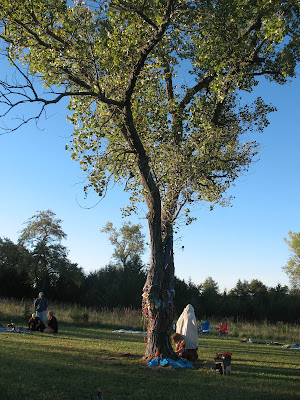
The Grandfather Tree a step back.

Me working my mesa with some Aqua de Florida during one of the breaks. And yes, those are girly pajama pants!


I am on the right along setting up my mesa along with an amazing collective of medicine workers, including the Honorable Reverend Daniel Levi (D-2) on the far left, Teri an amazing curandera one to the right, and Alan is the gentleman smoking his pipe behind me and one of the greatest drummers and drum-makers in the country.

A close-up of the Grandfather Tree and all the prayers surrounding him. We made 88 prayer ties each.
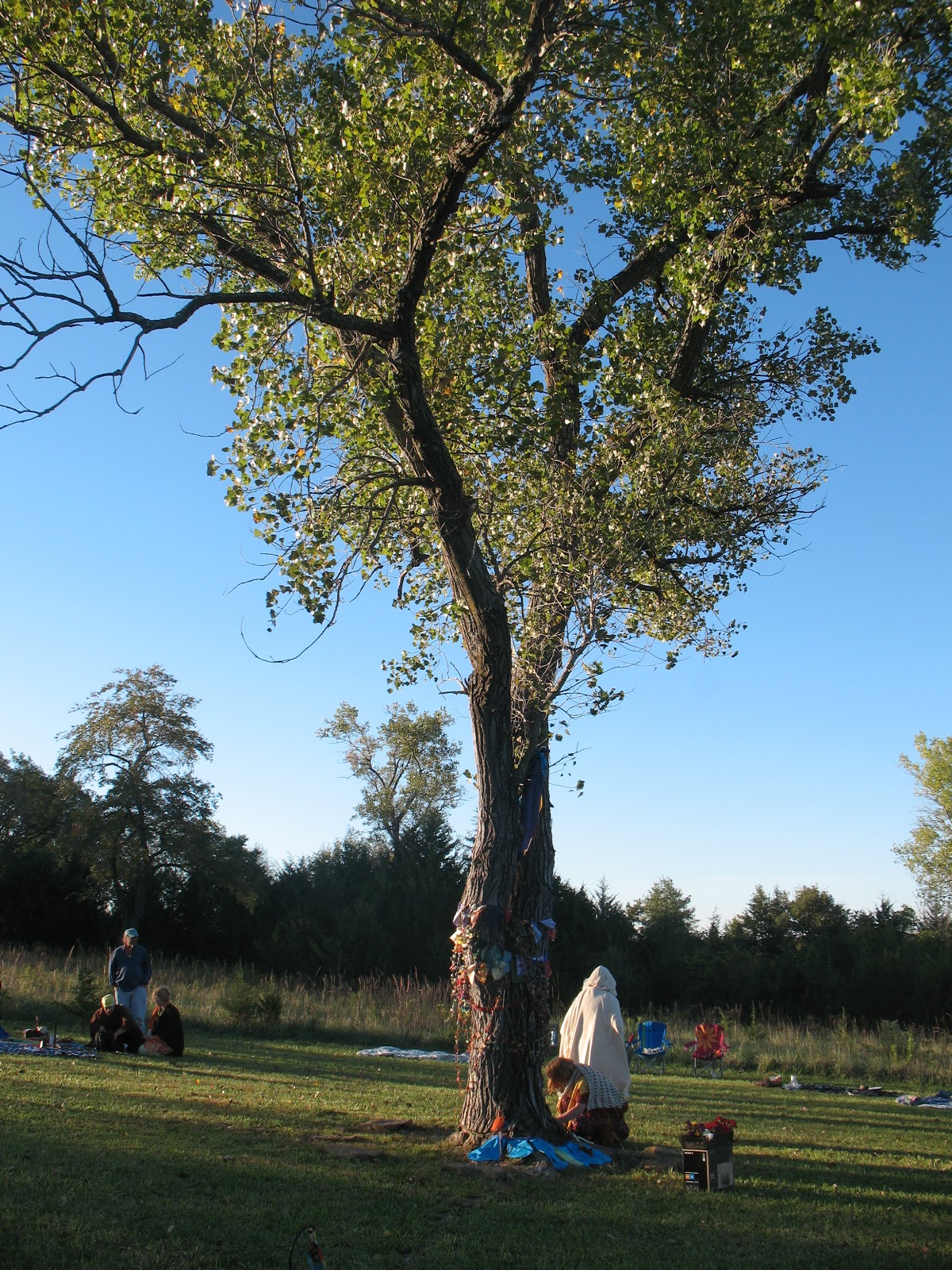
The Grandfather Tree a step back.

Me working my mesa with some Aqua de Florida during one of the breaks. And yes, those are girly pajama pants!

More of the Grandfather, with a view of the Northern Gate into the Circle. It was a marvelous time and I thank Susan whole-heartedly for the experience! I look forward to dancing the Flower Dance again soon...

I love Lord Hanuman.
I have always been interested in Hindu lore. The Bhagavad-Gita is one of the greatest holy books I have read and the pantheon of Hindu deities inspires the imagination. Admittedly though, I had never heard of Hanuman until I heard a song by Krishna Das called "Baba Hanuman" in January while walking into a store. Flooded over with emotion, my heart fluttering, I immediately purchased the CD. Ever since, Hanuman has been a guiding principle in my life.
Hanuman is a formidable warrior, scholar and musician, and the ultimate embodiment of devotion. In fact, he is known as Bhakta Avatar, the personification of devotion. The tattoo of Rama and Sita on his chest is a symbol of that devotion. It is his complete love and faith in Rama that manifests his immense strength, impeccable speed, impossible flight, and other superhuman skills which allow him to fulfill his service to his beloved Master. His is the slayer of Ravanas, of demons. It is said that to this day Hanuman patiently stands outside his cave in the Himalayas, scanning the horizon for Lord Rama's return.
Meditating on Hanuman ever since has taught me much about being a servant to the cause of righteous action. I frequently meditate on the words provided by Krishna Das and would like to post them here:
Namo...Namo...Anjaninandanaaya
Jaya Seeya Raama, Jai Jai Hanuman
Jaya Bajrangbalee, Baba Hanuman
Sankata Mochan kripaa nidhann
Jai Jai Jai Hanuman Gosaaee
Kripaa karahu Gurudeva kee naaee
Sankata Mochan kripaa nidhaan,
Laala Langotta, Laala Nishaan
Hare Raama Raama Raamam Seetaa Raama Raama Ramma

(or, Why Terence McKenna Matters)
If anyone ever wanted to get to know me (i.e. - what makes Daniel tick) the first thing I would have to tell them is, "Read Terence McKenna." In online forums and real life scenarios alike, I quote McKenna like Jules Winnfield quotes Ezekiel in Pulp Fiction. Passionate. With conviction. My armor and weapon when I'm ready to blast the meandering monotony of day-to-day living. However, most people ask, who is this guy? What exactly is the Terence McKenna circus? And, what makes him so important?
A few weeks ago my friend Michelle suggested I write a "Terence for Dummies" piece. So, since "For Dummies" is under copyright, here's my bent on the McKenna legacy: "Machine Elves 101: Why Terence McKenna Matters."
The Background
Terence Kemp McKenna was born in 1946 under the auspices of a conventional upbringing. His brother, Dennis, shared a penchant for the eccentricities of the fringe. Not unlike most psychopomp aficionados, McKenna's introduction to the realm of psychedelic phenomena came through Aldous Huxley's The Doors of Perception. The seed planted by this classic experiential account never left the McKenna boys in their ever-growing studies in philosophy and the sciences. After attaining his B.S. in Ecology and Conservation at U.C. Berkeley, Terence moved to Japan, eventually travelling throughout Southeast Asia until his mother died from cancer in 1971. A year later, Terence, Dennis, and friends made a long-awaited trek into the lower Putumayo of the Amazon Basin in search of a shamanic plant preparation called oo-koo-hé. The death of their mother, and the trials that came with Western society, was evident in their escape into the wilds of the rainforest. "We are at last freed of our umbilical connection to civilization," wrote Terence in his journal the first day on the river. (1) Dennis makes this sentiment clear as well, in a letter to his brother a year before their expedition: ". . . I have considered that [this journey] may well give us, as living men, willful access to the doorway that the dead pass daily." (2) Though their trip was specific to the exploration of a particular ceremonial medicine, it was indeed part of a larger quest in the spirit of imagination and exploration, to investigate the capacities of psychedelic consciousness.
Settling on the outskirts of the Mission at La Chorrera, it was the events that transpired during this crusade that became the catalyst of McKenna's ideas.
The Experiment
It was here that Terence and his party became acquainted with Stropharia cubensis fungi (now known as Psilocybe cubensis). The psilocybin alkaloid in this particular mushroom is part of the tryptamine class, which bears a structural relationship to serotonin in the human brain. Particularly, the correlation of biochemical functions between tryptamines and serotonin is what inspired them. In their experiments, Terence and Dennis pursued through firsthand experience the "phenomenology of the tryptamine dimension." (3) The study involved Terence and Dennis as guinea pigs, testing out this hypothesis: "Hallucinogens, by effecting the neural matrix, can produce changes in consciousness in the temporal dimension." (4) The temporal phenomena experienced here is not just described as pertaining to the dimension of time, but that of the physical or material world as well.
In essence, you can change reality while tripping on ‘shrooms.
The bread crumbs leading the McKenna brothers to this perspective was in fact the shamanic method. The Amazonian medicine ayahuasca—brewed from the Banisteriopsis caapi vine mixed with shrub leaves containing dimethyltryptamine (DMT)—is used by indigenous ayahuasceros or curanderos (curers) as a sacrament and medicine to heal the sick. Called "The Vine of the Dead," ayahuasca is renowned for giving healers supernatural abilities such as the ability to speak with the dead, with animals, and with plants; telepathic communication; curing physical, emotional, and spiritual ailments of all kinds, including addiction; and finally divination. Terence wrote: "By entering the domain of plant intelligence, the shaman becomes, in a way, privileged to a higher dimensional perspective on experience." (5) These fantastical attributes inspired Terence and his brother to apply the Baconian practice of scientific investigation with shamanic faculty.
Undergoing a lengthy binge in psilocybin mushrooms, they put this hypothesis to the test.

The Result
Time stopped, became tangible. Encounters with a UFO. No sleep for eleven days without any physical strain. These are just some of the phenomenal developments manifested during the experiment at La Chorrera. To summarize their conclusions, Terence and Dennis postulated that "all phenomena are at root constellated by a waveform that is the hierarchical summation of its constituent parts, morphogenetic patterns related to those in DNA." (6) Basically, that time is an objective apparatus acting as a wave (instead of the linear line framework we get from historiography) and that all events and thought forms are the development of that wave's motion. The back and forth motion, or crest and trough, of this wave is represented by critical moments in history they call novelty: the discovery of fire, the birth of agriculture, the creation of the Mona Lisa, the invention of the steam engine, the assassination of Archduke Franz Ferdinand, and so on. "Time is a topological manifold over which events must flow subject to the constraints of the manifold [...] by examining time from this point of view we can see when in history great outbreaks of novelty occurred." (7) Within this waveform the brothers found a pattern of novelty, a cycle in which the time spans become shorter and shorter. When this pattern ends it becomes a singularity, a zero point. Using a computer program they wrote, the McKenna brothers traced this zero point to an approximate location on our calendar and found it correlating with the end of the Mayan Calendar on December 22, 2012.
Now, keep in mind this theory was presented in 1975, long before the 2012 hype. Before the 21st Century, the 2012 phenomenon was almost exclusively in the McKenna camp. Most all of the apocalyptic doomsayers saw 2000, Y2K, or maybe even Ronald Reagan's Presidential reign as the cusp of Armageddon. But, did the McKennas really see this as the end of the world?
The Revival
"So historical patterns are largely cyclical, but not entirely—there is ultimately a highest level of the pattern, which does not repeat, and that's the part that is responsible for the advance into true novelty." (8)
Terence McKenna spent a large part of his career after this experiment attending lectures and seminars. He had become an emerging figure of the counter-culture, psychedelic movement, filling a void that had long been empty since the quiet death of the hippie movement in the early 1970s. Through his story-telling prowess, he regularly testified his arduous transition from Platonic philosopher to psychonautic proselytizer. The common pattern found in the majority of his presentations is a deconstruction of the modern, consumerist tendencies that pervade Western society. These tendencies are represented as the "dominator" model: "hierarchical, paternalistic, materialistic, and male dominated." (9) What Terence saw as the zero point at the end of history would actually manifest as the dissemination of the dominator value system. This period would be characterized as the "passing out of one set of laws that are conditioning existence and into another radically different set of laws." (10)
This end point is a chaotic and trying time. Terence recognized this shift in the world around us and did not lack a compass for which he could direct this oncoming transformation. "The last best hope for dissolving the steep walls of cultural inflexibility that appear to be channeling us toward true ruin is a renewed shamanism," he wrote. (11) "In the view of our present cultural impasse, I conclude that the next evolutionary step must involve not only a repudiation of dominator culture but an Archaic Revival." (12)
The Archaic Revival is McKenna's notion of our saving grace. It is a social recovery of the value systems that have been lost since the late Neolithic Age and can be surmised by these three aspects:
· The tribalization of society, reminiscent of the Goddess-worshipping days before agriculture.
· A sense of planetary connectedness as a primary component of all cultural habits and policy.
· Instead of values being imposed from external agencies, they should be discovered in the inner realms through various forms of consciousness expansion.
What this Revival looks like in the McKenna framework is a symphony of imagery described as "energy unbounded by space or time," a "quantum jump," or a "revelation of the interspecies' mind" as an experiential "confrontation with the Jungian 'collective unconscious'." (13). Whatever the result, the role of the tryptamine is vital to this paradigm shift into the Archaic Revival. Simply put, psychedelics of the entheogenic (plant spirit medicine) class are ego-suppressors. This is the cardinal remedy for the dominator problem afflicting us, because "they dissolve boundaries whatever the boundaries are. And as a consequence of this they dissolve cultural programming." (14)

The Elves
“There are forces friendly to our struggle to birth ourselves as an intelligent species.” (15) The elf component is the spice in the Terence McKenna flavor.
It is the supernatural entities encountered during his tryptamine experiences that compose the language of McKenna’s Archaic pulpit. "In the phenomenon of Stropharia cubensis, we are confronted with an intelligent and seemingly alien life-form.” (16) McKenna recounts time and time again the analogous experiences with these entities, what he calls “self-transforming machine elves” which one can make contact with in the psychedelic universe. “Right here and now, one quanta away, there is raging a universe of active intelligence that is transhuman, hyperdimensional, and extremely alien.” (17) What this suggests is that the psilocybin experience opens the pathways to a sort of parallel dimension, where one can speak and interact with otherworldly beings. The intrigue of this lies in its repeatability of these alien forms and the nature of their interactions: “This spectacle of more than Oriental splendor is the characteristic, even unvarying, manner in which this experience presents itself.” (18)
In fact, these elfin beings are a construct of a greater picture. Terence makes it clear the “speaking entity” of the tryptamine realm is an interior manifestation of the Logos, the ultimate source of all knowledge. The machine elves act as a sort of ambassadorship for the Logos, the collective unconscious, Oversoul, or Gaian Mind. It is from this place that Terence received the knowledge of his time wave theory: “Shamans and mystics and psychedelic travelers may be getting a very noisy, low-grade signal about a future event that is somehow built into the structure of space and time.” (19)
Again, the shamanic model makes itself evident. In indigenous societies, the shaman receives all of his/her knowledge from the same type of beings through entheogenic plants; it is integral to the success of their curing methods. “The shaman is able to act as an intermediary between the society and the supernatural, or to put it in Jungian terms, he is an intermediary to the collective unconscious.” (20)
The Gist
“A reinstitution of the shamanic role in modern society might prevent its total estrangement from the collective unconscious, which remains the fountainhead of all human cultures, archaic and modern.” (21)
Terence McKenna evolved to a sort of psychedelic prophet. The Village Voice called him the “Copernicus of consciousness.” The reason I feel he has something to offer society is because he recognizes that the current system is broken. It doesn’t serve the community; rather the community serves the system. McKenna’s approach was to turn the value system of modernism upside down. And although at first glance it may seem Terence was obsessed only with the naked embrace of the natural world, he was not without practicality. Indeed he felt technology was a problem-solving mechanism that would help get us out of this mess. “I think the electronic shaman—the person who pursues the exploration of these spaces—exists to return to tell the rest of us about it.” (22)
Are his ideas totally out there? Absolutely they are! But, that is precisely the point. The McKenna recipe is about finding a new language in which to understand our world. Because our current model of operating is so damaging to our way of life that it might actually end our life, it will take an absolute and agonizing reappraisal of our situation. However, Terence will be the first to admit that he doesn’t have the complete answer to this enigma: “You have to take seriously the notion that understanding the universe is your responsibility, because the only understanding of the universe that will be useful to you is your own understanding.” (23)
In conclusion, Terence McKenna was a scientist turned gypsy spokesperson for the shamanic realms. His claim is that by ingesting certain plants we come into contact with an objective reality that has a message for us. That message is about returning to a way of living that is more conscious of the Earth as personality, rather than a resource to tap. It is Terence’s contention that the plant spirits are trying to tell us this and that it is imperative to tune in to their frequency. “Nature is not our enemy, to be raped and conquered. Nature is ourselves, to be cherished and explored. Shamanism has always known this, and shamanism has always, in its most authentic expressions, taught that the path required allies. These allies are the hallucinogenic plants and the mysterious teaching entities, luminous and transcendental, that reside in that nearby dimension of ecstatic beauty and understanding that we have denied until it is now nearly too late.” (24)
But taking ourselves too seriously is not part of the McKenna formula. The great attractor to Terence McKenna as counter-culture icon was his insistence on having a good time. When asked in an interview by David Brown what the ultimate goal of human evolution was, Terence’s judicious response was plainly: “Oh, a good party.” (25)

.................Terence Kemp McKenna: November 16, 1946 – April 3, 2000.................
Footnotes
1. True Hallucinations, p.23
2. True Hallucinations, p.5
3. The Invisible Landscape, p.98
4. The Invisible Landscape, p.74
5. Food of the Gods, p.8
6. The Invisible Landscape, p.111
7. Chaos, Creativity, and Cosmic Consciousness, p.11
8. The Archaic Revival, p.215
9. The Archaic Revival, p.149
10. True Hallucinations, p.199
11. Food of the Gods, p.98
12. Food of the Gods, p.92
13. The Invisible Landscape, p.176
14. The Archaic Revival, p.243
15. Food of the Gods, p.13
16. True Hallucinations, p.209
17. The Archaic Revival, p.38
18. The Invisible Landscape, p.114
19. Chaos, Creativity, and Cosmic Consciousness, p.156
20. The Invisible Landscape, p.12
21. The Invisible Landscape, p.27
22. The Archaic Revival, p.165
23. The Archaic Revival, p.88
24. Food of the Gods, p.274
25. The Archaic Revival, p.210
Bibliography
Abraham, Ralph, Terence McKenna, and Rupert Sheldrake. Chaos, Creativity, and Cosmic Consciousness. Park Street Press, 2001.
McKenna, Dennis and Terence McKenna. The Invisible Landscape: Mind, Hallucinogens, and the I Ching. San Francisco: Harper Collins, 1993.
McKenna, Terence. The Archaic Revival: Speculations on Psychedelic Mushrooms, the Amazon, Virtual Reality, UFOs, Evolution, Shamanism, the Rebirth of the Goddess, and the End of History. San Francisco: Harper Collins, 1991.
McKenna, Terence. Food of the Gods: The Search for the Original Tree of Knowledge. Bantam, 1993.
McKenna, Terence. True Hallucinations: Being an Account of the Author’s Extraordinary Adventures in the Devil’s Paradise. San Francisco: Harper Collins, 1993.
Tonight I made my first smudge wand:

The large feather is a little over a foot long, a turkey feather my wife and I found walking in the woods. We found the smaller feathers later that same walk as well, but could not identify them. The handle is made from wood, wrapped in suede leather and hemp rope. To secure the leather and knots, I used a special eco-friendly leather glue that can be found at Michael's hobby store. I constructed the whole thing in candle light. Once completed, I blessed it with frankincense, aqua de florida, and (of course) sage. It makes a great addition to my mesa, sitting with my other Wiracocha feather.
I'm pretty proud. It's my first self-made shamanic object. Next, I aim to work on either a walking or chonta staff.

The large feather is a little over a foot long, a turkey feather my wife and I found walking in the woods. We found the smaller feathers later that same walk as well, but could not identify them. The handle is made from wood, wrapped in suede leather and hemp rope. To secure the leather and knots, I used a special eco-friendly leather glue that can be found at Michael's hobby store. I constructed the whole thing in candle light. Once completed, I blessed it with frankincense, aqua de florida, and (of course) sage. It makes a great addition to my mesa, sitting with my other Wiracocha feather.
I'm pretty proud. It's my first self-made shamanic object. Next, I aim to work on either a walking or chonta staff.

Her Name is E'strella.
I'm not sure if I am completely done with this, but I guess I am for now.
I am working on a new project. A CD full of poetry and songs from my brain. Hopefully it will be complete by mid-Spring. Here is the cover to the album:

I will be blogging more soon. It's been a rough winter. Spring is inching around the corner.....

I will be blogging more soon. It's been a rough winter. Spring is inching around the corner.....


